
If you have ever wrestled a pitot tube in the middle of a charged hydrant stream, you already know two things. It is harder than it looks. And you are going to get wet.
Most fire protection teams rely on flow devices from companies like The Hose Monster Company, HYDRA-TAP and Flow Buster for routine testing. But certain applications still call for a traditional pitot tube — and when they do, accuracy is everything. So what is the proper way to measure pitot pressure during a hydrant flow test? The answer lives inside NFPA 291, “Recommended Practice for Water Flow Testing and Marking of Hydrants” 2025 edition.
What NFPA 291 Says
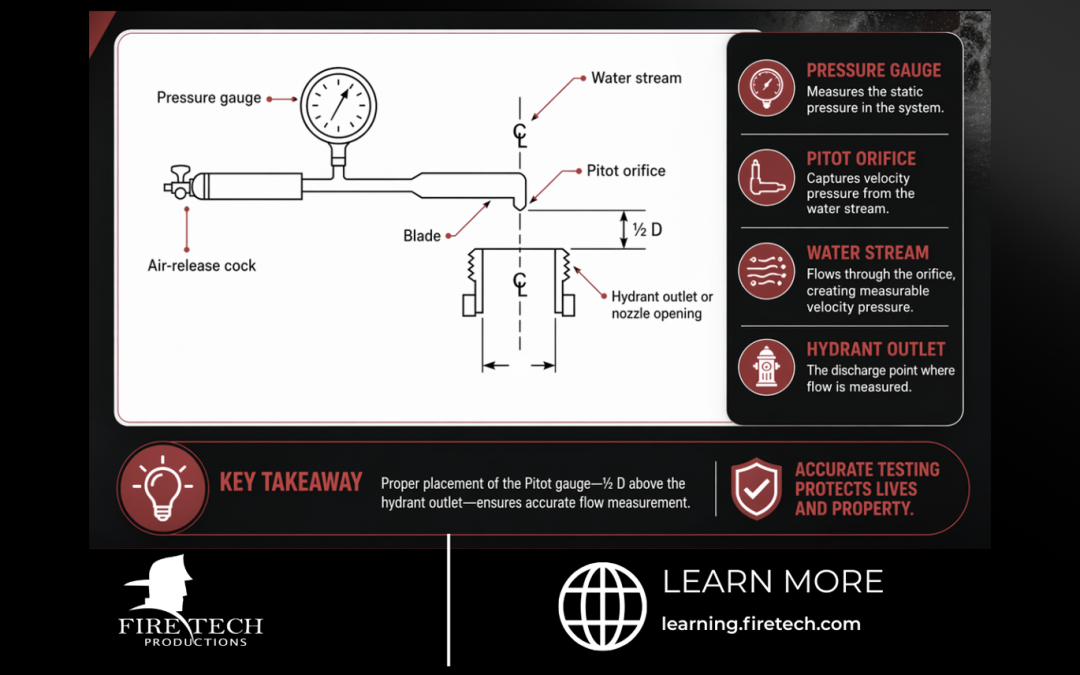
Open Chapter 4 and turn to Section 4.8.3: “When measuring the pitot pressure of a stream of practically uniform velocity, the orifice in the pitot tube is held downstream approximately one-half the diameter of the hydrant outlet or nozzle opening, and in the center of the stream.” Two takeaways jump off the page:
- First, the pitot blade must sit in the center of the stream. Off-center readings skew your numbers and give a false picture of available flow.
- Second, hold the blade one-half the diameter of the outlet away from the face. For a 2 1/2-inch outlet, that is 1 1/4 inches downstream. For a 4-inch outlet, 2 inches. The math is easy. Holding steady in a blasting stream is not. Bring the right gear and a teammate.
Gauge Requirements
Section 4.6.1(3) calls for “a pitot tube and a 100 psi bourdon pressure gauge with 1 psi graduations.” A liquid-filled gauge is your best friend here. It dampens needle bounce so you can lock in a clean reading. Your gauge reading may not completely settle; the liquid in the gauge will minimize the needle bounce, but will not eliminate it. This is normal.
Once you capture the reading, Section 4.9.3 gives you the formula to convert psi into gallons per minute.
Why It Matters
Hydrant flow data drives sprinkler design, fire pump sizing and ISO ratings. A bad pitot reading throws every downstream calculation off — and that puts property owners, AHJs and firefighters at risk. NFPA 291 is the baseline, and it pairs naturally with the work you are already doing toward NICET certification.
Train With Fire Tech
You do not have to learn this the hard way. Fire Tech offers self-paced online courses and hands-on workshops built for inspectors, contractors, designers and AHJs.
Browse the full catalog at learning.firetech.com, or email me directly at rob@firetech.com to build a custom training plan for your crew.
Stay safe, stay accurate (and bring a towel).
—–
Rob Stewart is the Director of Training at Fire Tech Productions, with 30 years in the Fire Protection Industry.


