The best fire protection teams aren’t built in a classroom alone. Research from the Association for Experiential Education consistently shows that hands-on, experiential learning drives significantly higher retention than passive instruction — and Edutopia reinforces that finding, noting that experiential learning deepens comprehension, builds problem-solving skills and increases a learner’s ability to transfer knowledge to new situations.
For a fire protection company, that transfer shows up on the bottom line. When one of your technicians is standing in front of a fire pump that won’t meet its rated flow, or tracing a supervisory signal that shouldn’t be active, the gap between knowing the theory and acting on it is the gap between a job closed on the first visit and a second truck roll. Fire Tech’s hands-on workshops are designed to close that gap for your team — fast.
Why Hands-On Training Hits Different in Fire Protection
Online courses are a proven, efficient way for your team to build knowledge of the standards, earn CEUs and prepare for certification exams. But certain skills simply can’t be developed through video and reading alone.
Working with fire pumps, alarm valves, dry pipe valves and fire alarm devices requires tactile familiarity — an understanding of what normal looks, sounds and feels like so abnormal is immediately recognizable. That familiarity only comes from time on the equipment.
NICET certifications test applied knowledge, not just recall of the standards. Technicians who have physically performed the tests and procedures described in NFPA standards consistently perform better on exams — and, more important for your business, better in the field after they pass.
Fire Tech’s Hands-On Workshops are built on that principle: For a team of fire protection technicians and ITM professionals, hands-on training isn’t a supplement to professional development. It’s the foundation.
What Your Team Will Learn in a Fire Tech Workshop
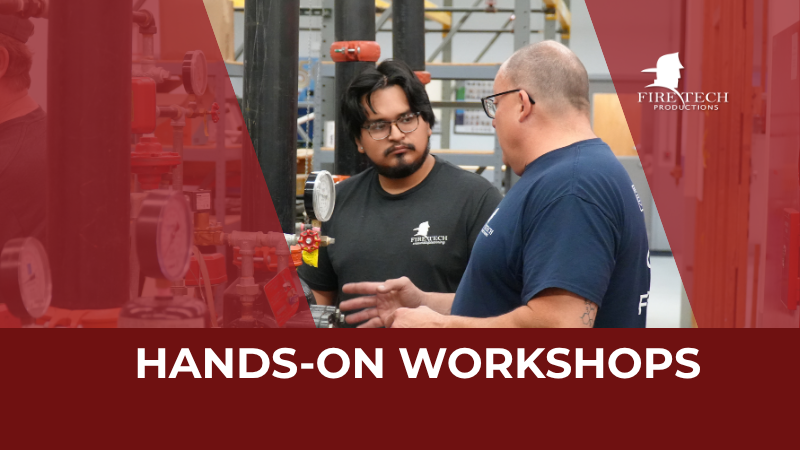
Fire Tech workshops are structured around the real tasks, real systems and real decision points your technicians encounter in the field. Depending on the workshop, participants work directly with:
Fire pump equipment — Your technicians will perform no-flow and flow tests, read gauges and interpret results, inspect electric and diesel pump controllers, and identify common deficiency conditions. They won’t just know what NFPA 25 requires for pump testing — they’ll have done it.
Fire alarm panels — Your technicians will work hands-on with fire alarm control units: reading and acknowledging alarm, supervisory and trouble signals, tracking down ground faults and open circuits, and testing initiating devices and notification appliances to NFPA 72. Technicians who can find the root cause at the panel close more service calls on the first visit and spend less time on the phone asking for help.
Sprinkler systems — Participants inspect and test wet, dry and preaction sprinkler systems from the riser to the inspector’s test connection. They perform main drain tests, check gauges and trim, and learn to spot corrosion, obstructions and impaired components before they turn into failures. Your team walks away knowing what a healthy system looks like and how to document one that isn’t, just as NFPA 25 requires.
Waterflow alarms and testing procedures — Participants conduct inspector’s test valve procedures, verify alarm activation times, verify tamper switch function, practice the documentation required after each inspection, and work through the notification protocols required under NFPA 25. Timing, documentation and proper restoration steps are all covered in a live setting.
Deficiency identification and classification — One of the most valuable exercises puts your technicians through real-world deficiency scenarios. They’ll practice classifying conditions as critical or noncritical, determine the correct notification chain and document findings the way an AHJ expects to see them.
Every instructor has been in your technicians’ boots. Throughout every session, Fire Tech instructors bring field experience into the room — connecting each procedure back to the language in NFPA codes and standards, and to the practical realities of working with your customers, building owners, and authorities having jurisdiction. Send your team ready to get their hands dirty. They’ll walk in as techs. They’ll walk out sharper.
→ Find the right workshop for your team
How Workshop Training Accelerates Your Team
Hiring experienced technicians is tougher than ever, and in many markets the same people simply move from company to company. The fastest way to grow capacity is to develop the team you already have. Confident technicians don’t have every answer memorized. They’ve done the work enough times that the right next step feels instinctive.
Workshops accelerate that growth in four concrete ways.
- They compress experience. What might take months of on-the-job exposure is deliberately built into a single intensive training environment. Your technicians see more system types, more deficiency scenarios and more documentation challenges in two days than most see in a quarter.
- They build diagnostic instinct (faster troubleshooting, fewer callbacks and return trips to customer sites)
- They validate and fill knowledge gaps (spotting blind spots before a customer or AHJ does)
- They build cross-trained, flexible teams (shared skill sets let technicians float between departments and cover more work per trip)
FAQ
- Is hands-on training worth it if my team has already completed online coursework?
Online courses build your team’s knowledge of the standards and prepare technicians for exams, but a hands-on workshop builds tactile skills they can’t get from video alone — Fire pump diagnostics, operating valves and recognizing abnormal conditions on real equipment. - Which team members should attend a Fire Tech workshop?
Fire Tech’s workshops are built for working fire protection technicians and inspection, testing and maintenance (ITM) professionals — from newer hires who need time on real equipment to experienced techs cross-training into a new discipline. But designers that need a better understanding of what and how to design, supervisors who need cross training to effectively manage their technicians, administrative staff that works with scheduling and invoicing, and sales staff looking to better understand how their services work all benefit as well. - Will a workshop help my technicians pass their NICET exams?
Every procedure in a Fire Tech workshop ties directly back to real-world scenarios and current NFPA codes and standards. Candidates who have physically performed practical procedures and tests consistently show stronger exam results and stronger performance in the field afterward. - How should my team prepare before attending?
Have participants review the NFPA sections related to their workshop topic. All workshop participants receive the appropriate workbooks and NFPA code book (with Fire Tabs!) when they arrive at the workshop. - How do I find the right workshop for my team?
Browse Fire Tech’s workshop schedule for sessions built around fire pumps, sprinkler valves, waterflow alarms and deficiency classification, then register the technicians whose discipline and experience level match. - Where can my team find additional study materials after the workshop?
Fire Tech’s Bookstore has guides, standards and reference materials that reinforce what your technicians learned hands-on and help them keep building on it.


