
By Shawn Lee, Fire Alarm Program Director, Fire Tech Productions
Last reviewed: November 5, 2026, against NFPA 72, National Fire Alarm and Signaling Code, 2025 edition
| Key Takeaways: NFPA 72, 2025 edition, sets visual inspection frequencies for initiating devices in Table 14.3.1, Item 17. Most devices, including smoke detectors, heat detectors, manual fire alarm boxes, and waterflow and supervisory devices, require semiannual inspection. Radiant energy and video image detectors require quarterly inspection. Every inspection verifies device location and condition. |
A renovation wraps up, the contractor leaves, and a dust cover stays on a smoke detector in the corridor. Nothing on the panel tells you. The detector reports normal, and it will keep reporting normal until a fire proves otherwise. Only a visual inspection catches it.
Inspection is the part of ITM that relies on your eyes and judgment instead of a test set. Let’s review what NFPA 72, 2025 edition, requires when you inspect initiating devices: how often, what to verify, and what to do when you find a problem. Please note that testing and record-keeping requirements are outside the scope of this post.
What Does NFPA 72 Require for Initiating Device Inspection?
Section 14.3.1 requires visual inspections in accordance with the authority having jurisdiction or Table 14.3.1, whichever is more frequent. The table sets the floor, and the AHJ can raise it.
For initiating devices, Table 14.3.1, Item 17, sets one method for every device: verify location and condition. Several device types carry additional, specific checks, which I’ve covered below.
Two other parts of NFPA 72 shape every initiating device inspection:
- Item 1, All equipment (annual). Inspect for building modifications, occupancy changes, changes in environmental conditions, device location, physical obstructions, device orientation, physical damage, and degree of cleanliness. The purpose, stated in Section 14.3.5, is to assure there are no changes that affect equipment performance.
- Initial and reacceptance inspections. Every Item 17 device requires inspection at initial acceptance. Section 14.3.4 requires initial and reacceptance inspections to ensure compliance with approved design documents and installation in accordance with the Code.
Section 14.2.2.1.1 also requires ITM programs to conform to the equipment manufacturer’s published instructions, so be sure to check the manufacturer’s inspection requirements for each device type. Keep Table 14.3.1 within reach with Fire Tech’s NFPA Tabbed Codes & Standards.
How Often Must Each Initiating Device Be Inspected?
Semiannual is the standard interval for initiating devices. The exceptions are radiant energy and video image detectors (quarterly), duct detector sampling tubes (annual), and air sampling piping and ports, which carry no minimum periodic frequency. Here is the full breakdown from Table 14.3.1, Item 17:
| Initiating Device (Item 17) | Periodic Frequency | Device-Specific Method |
| (1)(a) Air sampling, general | Semiannual | Verify that in-line filters, if any, are clean. |
| (1)(b) Air sampling, piping and sampling ports | N/A (initial acceptance only) | Verify piping and fittings are installed properly, appear airtight, and are permanently fixed. Confirm sampling pipe is conspicuously identified. Verify sample ports or points are not obstructed. |
| (2)(a) Duct detectors, general | Semiannual | Verify the detector is rigidly mounted. Confirm no penetrations exist in a return air duct in the vicinity of the detector. Confirm the detector samples the airstream at the proper location in the duct. |
| (2)(b) Duct detectors, sampling tube | Annual | Verify proper orientation. Confirm the sampling tube protrudes into the duct in accordance with system design. |
| (3) Electromechanical releasing devices | Semiannual | Location and condition |
| (4) Fire extinguishing or suppression system switches | Semiannual | Location and condition |
| (5) Manual fire alarm boxes | Semiannual | Location and condition |
| (6) Heat detectors | Semiannual | Location and condition |
| (7) Radiant energy fire detectors | Quarterly | Verify no point requiring detection is obstructed or outside the detector’s field of view. |
| (8) Video image smoke and fire detectors | Quarterly | Verify no point requiring detection is obstructed or outside the detector’s field of view. |
| (9) Smoke detectors (excluding one- and two-family dwellings) | Semiannual | Location and condition |
| (10) Projected beam smoke detectors | Semiannual | Verify beam path is unobstructed. |
| (11) Supervisory signal devices | Semiannual | Location and condition |
| (12) Waterflow devices | Semiannual | Location and condition |
Source: NFPA 72, 2025 edition, Table 14.3.1. In the table, N/A means no minimum periodic requirement is established.
What Should You Look for at Each Device?
Look for anything that keeps a device from sensing, being reached, or reporting as designed. The Code’s method is short, but the field conditions behind it vary by device type.
- Smoke Detectors: Confirm each detector is present, undamaged, and properly secured. Look for dust covers, bags, or tape left after construction, and for paint overspray. Table 14.3.1 has no exception for detectors with panel-based contamination monitoring. A dirty-detector signal will not reveal a covered head.
- Heat Detectors: Check for mechanical or water damage, paint, and secure mounting. Watch for building changes that alter the device’s effectiveness, such as a removed drop ceiling that leaves a detector hanging below the deck.
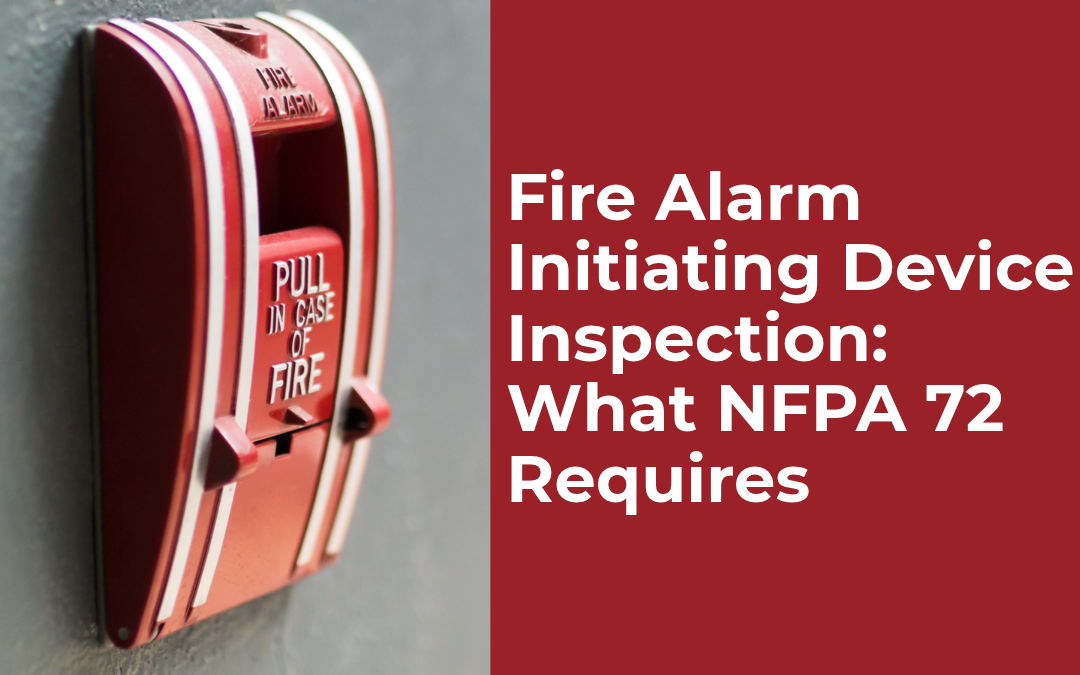
- Manual Fire Alarm Boxes: Note physical damage and confirm unobstructed access. Furniture, storage boxes, and displays migrate in front of pull stations between visits.
- Duct Detectors: Confirm nothing blocks smoke entry, and that the sampling tube orientation matches the manufacturer’s published instructions.
- Radiant Energy and Video Image Detectors: Stand at the detector. If you cannot see the entire protected area, the detector likely cannot either. Check for toolboxes, partitions, and lens contamination, and compare orientation against the record drawings.
- Supervisory and Waterflow Devices: For devices installed outdoors, confirm covers and watertight seals are in place and look for damaged junction boxes and gaskets.
- Suppression System Switches: Inspect the switch under NFPA 72. Inspect the suppression system itself under its governing standard, such as NFPA 12, NFPA 12A, NFPA 17, or NFPA 2001.
Can Inaccessible Devices Be Inspected Less Often?
Yes, with limits. Section 14.3.2 permits devices or equipment that are inaccessible for safety considerations to be inspected during scheduled shutdowns if approved by the AHJ. The Code lists these examples:
- Continuous process operations
- Energized electrical equipment
- Radiation
- Excessive height
Section 14.3.3 caps extended intervals at 18 months. The relief is tied to safety considerations, not inconvenience, and it requires AHJ approval.
What Happens When an Inspection Finds a Problem?
Correct it and tell the owner. NFPA 72 separates what you find into four categories:
- Section 14.2.2.3.1 requires system deficiencies to be corrected. If a deficiency is not corrected at the conclusion of inspection, testing, or maintenance, Section 14.2.2.3.2 requires the owner or the owner’s designated representative to be informed in writing within 24 hours.
- Some conditions go beyond a deficiency. An impairment is an abnormal condition, planned or emergency, in which a system, component, or function is inoperable. A visual inspection can uncover one. A missing detector with its conductors twisted together to clear the trouble signal is a deficiency, but if it was the only detector in the space, or several detectors are missing, the condition becomes an impairment. Impairments must be handled under Section 10.21, which includes notifying the owner or the owner’s designated representative and notifying the AHJ when the system is out of service for more than 8 hours.
- Recalled equipment. If you observe equipment that is part of a recall program, Section 14.2.2.3.3 requires written notification to the owner or the owner’s designated representative.
- Under Section 14.2.2.4, you may communicate observations to the owner. The owner is not required to address them unless they become an impairment or deficiency.
Section 14.1.6 adds an important boundary: periodic ITM does not require you to verify the adequacy of the design of an existing, previously approved system. Your job is to find what has changed, what is damaged, and what is blocked.
How Fire Tech Helps You Inspect With Confidence
A fire alarm system does not control or extinguish a fire the way a sprinkler or suppression system does. Its job is detection: initiating devices monitor the spaces they cover, sprinkler system waterflow, and sprinkler control valves, then report what they find. That job depends on every device sensing and reporting as designed. A missed detail during inspection can leave an area or valve unmonitored or improperly monitored for months, which could lead to loss of life or property. Catching those details is your job, and you deserve training that keeps pace with the Code.
For 40 years, Fire Tech Productions has helped fire protection professionals master industry standards. As a NICET Recognized Training Provider, we offer 300+ courses, workshops, and study materials, including preparation for NICET Inspection and Testing of Fire Alarm Systems certification.
- Choose Your Training: From online courses and hands-on workshops to exam prep bundles and in-person training, we have the resources you need.
- Master the Codes: Gain the knowledge and confidence to learn fire protection standards, pass your exams, and confidently mitigate risks.
- Get Certified: Become a fire protection expert and propel your career.
Explore more ways to grow in Fire Alarm Learning Paths and see how tabbed standards speed up lookups in Stop Wasting Precious Exam Time Flipping Pages.
Start Your Course: Inspection & Testing of Fire Alarm Systems Level I Course Package
Frequently Asked Questions
How often do smoke detectors require visual inspection under NFPA 72, 2025 edition?
Semiannually. Table 14.3.1, Item 17(9), sets a semiannual visual inspection for smoke detectors, excluding one- and two-family dwellings. The AHJ may require a more frequent schedule, and Section 14.3.1 requires whichever schedule is more frequent.
Which initiating devices require quarterly visual inspection?
Radiant energy fire detectors and video image smoke and fire detectors. Table 14.3.1, Items 17(7) and 17(8), require quarterly inspection to verify no point requiring detection is obstructed or outside the detector’s field of view.
Are waterflow and supervisory devices still inspected quarterly?
No. Table 14.3.1, Items 17(11) and 17(12), set a semiannual frequency for supervisory signal devices and waterflow devices. The interval moved from quarterly to semiannual in the 2022 edition, aligning these devices with most other fire alarm equipment.
Does panel contamination monitoring replace visual inspection of smoke detectors?
No. Table 14.3.1 contains no exception for smoke detectors with contamination monitoring. A dirty-detector signal reports sensing chamber condition, but it cannot reveal a dust cover, tape, or other obstruction left on the detector.
Can inspection of an inaccessible initiating device be deferred?
Yes, with AHJ approval. Section 14.3.2 permits devices inaccessible for safety considerations to be inspected during scheduled shutdowns. Section 14.3.3 limits extended intervals to 18 months. The relief is limited to safety considerations.Let’s review what NFPA 72, 2025 edition, requires when you inspect initiating devices: how often, what to verify, and what to do when you find a problem.
Sources
- NFPA 72, National Fire Alarm and Signaling Code, 2025 edition, Chapter 14, Sections 14.1.6, 14.2, and 14.3, and Table 14.3.1. NFPA 72 on nfpa.org
- NICET, Inspection and Testing of Fire Alarm Systems Certification Requirements


