
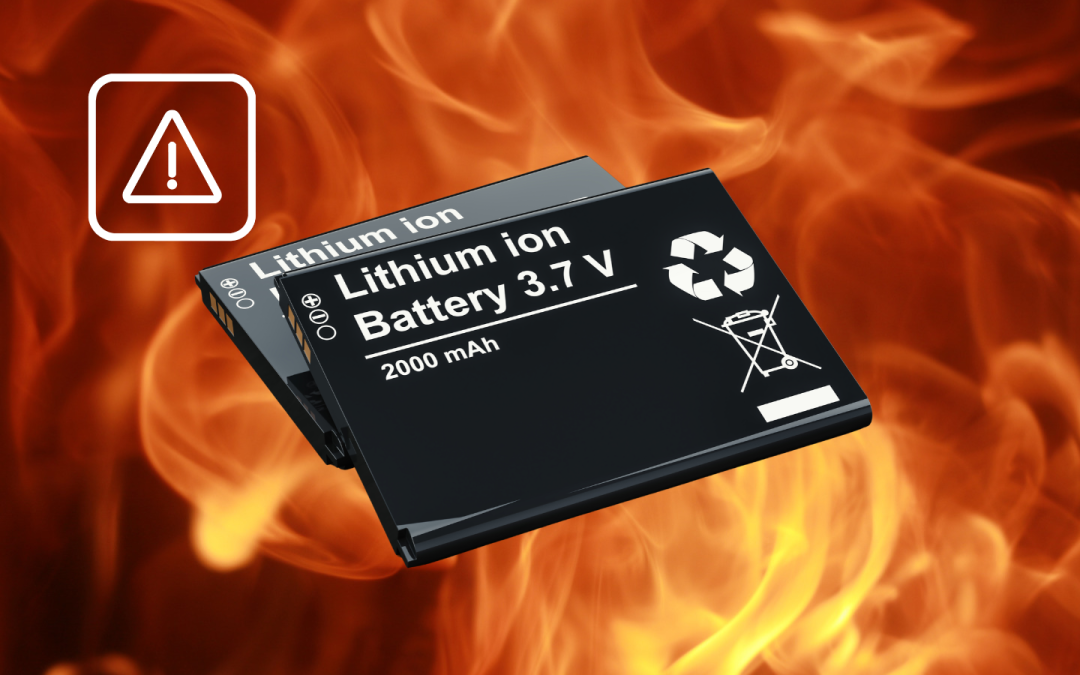
Walk any building you service and you’ll find lithium-ion batteries everywhere. Laptops charge at every desk, cordless tools charge in the shop, and e-bikes lean against the lobby wall. Meanwhile, more owners are adding battery storage to their solar arrays or wind turbines, often in a garage, a utility room, or a pad outside the back door.
When owners ask you what protection they need, the answer depends on which battery you’re talking about. So this guide breaks lithium-ion battery fire protection into two general parts, so you can give owners clear, code-based recommendations for both.
Why Does Lithium-Ion Battery Fire Protection Need Its Own Plan?
Lithium-ion batteries need a dedicated plan because a cell in thermal runaway makes its own heat and flammable gas. For example, damage, overcharging, manufacturing defects, or heat exposure can start the reaction, and one failing cell can drive its neighbors into runaway.
As a result, a battery fire can keep going after the visible flame goes out, release toxic and flammable gases, and reignite hours later. NFPA Journal described this gap between widespread use and safety in The Lithium-Ion Challenge. For that reason, the protection strategy has to account for prevention, early warning, cooling, and containment, not only extinguishment.
How Should Property Owners Manage Personal Devices and Power Tools?
Start with prevention, because most device fires begin with a damaged, counterfeit, or mismatched battery or charger. NFPA’s Lithium-Ion Battery Safety guidance supports a short list of controls you can recommend to every owner:
- Buy listed products: Require batteries, chargers, and devices listed by a nationally recognized testing laboratory, like UL Solutions, and ban aftermarket or counterfeit batteries.
- Use the manufacturer’s charger: Mismatched chargers are a common cause of overcharging, so keep each charger with its own device or tool. Be sure to regularly inspect the chargers as well and remove them from service immediately if they are damaged.
- Designate charging areas: Charge tools and equipment, powered devices, e-bikes, and scooters on noncombustible surfaces, away from exits, combustible storage, and sleeping areas.
- Stop using damaged batteries: Pull any battery that swells, leaks, smells odd, overheats, or makes noise, and take it out of service right away.
- Quarantine and recycle: Store damaged or spent batteries in a covered metal container away from combustibles and then send them to a battery recycler instead of the trash.
- Train occupants: Finally, staff should know the warning signs, how to evacuate, and when to call 911.
In commercial buildings, charging areas also deserve a look during your inspection. Confirm that smoke or heat detection covers the space, that sprinklers aren’t obstructed by charging racks, and that the area has the right extinguisher nearby.
What Suppression Works on Device and Tool Battery Fires?
In most cases, cooling works best, and water is the most effective cooling agent for small lithium-ion cells. An extinguisher can control flames and burning surroundings, but it won’t stop thermal runaway inside the cells.
The table below matches common situations to the response you should recommend.
| Situation | Recommended Response |
| Device smoking, hissing, or swelling, no flame | Unplug it if safe, move people away, and call 911. Don’t handle a hot battery with bare hands. |
| Small flaming device or tool battery | Evacuate the area and call 911. Trained staff may use water or a water-based extinguisher to cool the battery and surroundings if it’s safe. |
| Fire in energized equipment around the battery | Use an extinguisher listed for Class C hazards on the electrical equipment, then keep cooling the battery area. |
| E-bike or scooter battery fire | Evacuate immediately. These packs can release large volumes of gas and fire, so leave suppression to the fire department. |
| Battery fire that seems out | Treat it as active. Keep it isolated, because reignition is common, and let the fire department confirm it’s safe. |
Also keep in mind that NFPA 10, Standard for Portable Fire Extinguishers, doesn’t define a separate fire class for lithium-ion batteries. So review any product marketed as a “lithium-ion extinguisher” against its actual listing and test basis before you recommend it.
What Does NFPA 855 Require for On-Site Solar and Wind Battery Storage?
While Fire Tech doesn’t often get into NFPA 855, Standard for the Installation of Stationary Energy Storage Systems, we recommend you #NeverStopLearning. As alternative energy becomes more common, familiarizing yourself with additional standards is always a good idea. The 2026 edition of NFPA 855 governs battery storage paired with solar panels or wind turbines once it exceeds the standard’s thresholds. However, the path depends on the occupancy.
One- and Two-Family Dwellings
First, NFPA 855 has a dedicated chapter for residential Energy Storage Systems (ESS). Its key provisions include these requirements:
- Owners need systems listed to UL 9540, installed per the manufacturer’s instructions.
- NFPA 855 caps individual units at 20 kWh.
- It also caps aggregate capacity at 40 kWh in utility closets and storage spaces, and 80 kWh in attached or detached garages, accessory structures, and outdoor locations.
- Units need 3 feet of separation from each other unless large-scale fire testing supports closer spacing.
- ESS can’t go in living areas or sleeping rooms.
- Rooms and garages with ESS need smoke alarms or, where smoke alarms aren’t suitable, heat detection interconnected with the dwelling’s alarms.
- Units exposed to vehicle traffic need approved impact protection, such as bollards.
Commercial and Multifamily Properties
Above the residential path, the full standard applies, and the 2026 edition raises the bar. Thresholds apply per fire area, so several small systems can add up to a regulated ESS. In addition, owners should expect these requirements:
- A hazard mitigation analysis for most lithium-ion installations
- Large-scale fire test data that matches the installed configuration
- Automatic sprinklers per NFPA 13 as the baseline, with alternatives accepted only when fire testing and an HMA support them
- Explosion control through deflagration venting under NFPA 68 or explosion prevention under NFPA 69, where required
- A written emergency response plan with annual review and yearly refresher training
Also, the Fire Protection Research Foundation’s Sprinkler Protection Guidance for Lithium-Ion Based Energy Storage Systems is a useful reference when you discuss design density with the owner and the AHJ.
What Fire Protection Layers Belong Around On-Site Battery Storage?
Build protection in layers, because each one covers a different stage of a battery event. For most owners, a complete approach includes these steps:
- Locate it right. Put the ESS in an approved location with the required separation from doors, windows, and other units.
- Separate it. Use rated construction around indoor installations so a battery event stays a battery event.
- Detect early. Combine smoke or heat detection with off-gas detection where the design calls for it, and tie signals into the fire alarm system.
- Cool and control. Provide sprinkler protection designed to the test data, and keep sprinklers clear of battery cabinets.
- Vent the gas. Coordinate explosion control and exhaust with the mechanical and electrical trades.
- Plan the response. Post signage and disconnect locations, and give the fire department a current emergency response plan.
Then keep it maintained. Detection, sprinklers, and exhaust only protect the property if someone inspects, tests, and maintains them on schedule.
What’s at Stake for Owners and Contractors?
A single charging mistake or an undersized ESS layout can turn a routine battery failure into a building fire. Meanwhile, owners often assume that a battery vendor’s installation covers fire protection, which leaves gaps no one owns, and that means possible danger to life and property.
That’s where you come in. The contractor or inspector who can explain both hazards in plain terms becomes the owner’s trusted guide. For a refresher on how special hazards differ from traditional protection, see Traditional vs. Special Hazards Fire Suppression.
How Fire Tech Helps You Advise Owners With Confidence
Battery hazards change faster than many training programs, and owners expect you to have answers today. For nearly 40 years, Fire Tech Productions has helped fire protection and life safety professionals master the standards they use every day. As a NICET Recognized Training Provider and ICC Preferred Education Provider, we offer 300+ courses, workshops, and study materials.
- Choose Your Training: From online courses and hands-on workshops to exam prep bundles and in-person training, we have the resources you need.
- Master the Codes: Gain the knowledge and confidence to learn fire protection standards, pass your exams, and confidently mitigate risks.
- Get Certified: Become a fire protection expert and propel your career.
Build your foundation with Fire Tech’s Special Hazards Online Courses and the Special Hazards Level I Book Set. Next, sharpen your extinguisher knowledge with our Portable Extinguishers training, and pick up the current NFPA 855 from our NFPA Codes and Standards collection.
Frequently Asked Questions
Does NFPA 855 apply to a home battery paired with solar panels?
Yes, when the system falls within the standard’s residential provisions. NFPA 855 covers residential ESS with limits on unit size, aggregate capacity, location, and spacing. Then check the edition your jurisdiction has adopted, because many AHJs enforce these rules through the IRC or the fire code instead of NFPA 855 directly.
Can a standard ABC extinguisher put out a lithium-ion battery fire?
Not reliably. An ABC extinguisher can knock down flames and burning surroundings, but it doesn’t cool cells in thermal runaway, so reignition remains likely. Water cools more effectively, and the safest move for anything larger than a small device is to evacuate and call the fire department.
Where should employees charge power tools, scanning devices and e-bikes?
Charge them in a designated area on noncombustible surfaces, away from exits, combustible storage, and sleeping areas. The space should have detection and sprinkler coverage, plus an extinguisher nearby. Also, set rules that require listed batteries and manufacturer chargers.
Do battery rooms for solar or wind storage need sprinklers?
In most commercial installations, yes. NFPA 855 uses NFPA 13 sprinklers as the baseline for fire control and suppression. The AHJ may accept an alternative when fire testing and a hazard mitigation analysis support it, so confirm the design basis early.
How should owners store damaged lithium-ion batteries?
First, isolate them in a covered metal container away from combustibles until a battery recycler can take them. Also, never put them in the trash or a general recycling bin. Finally, label the container and keep it out of exit paths.
Sources
- National Fire Protection Association, Lithium-Ion Battery Safety.
- National Fire Protection Association, NFPA 855, Standard for the Installation of Stationary Energy Storage Systems, 2026 edition.
- Fire Protection Research Foundation, Sprinkler Protection Guidance for Lithium-Ion Based Energy Storage Systems.
- NFPA Journal, The Lithium-Ion Challenge, Nov. 15, 2024.


