
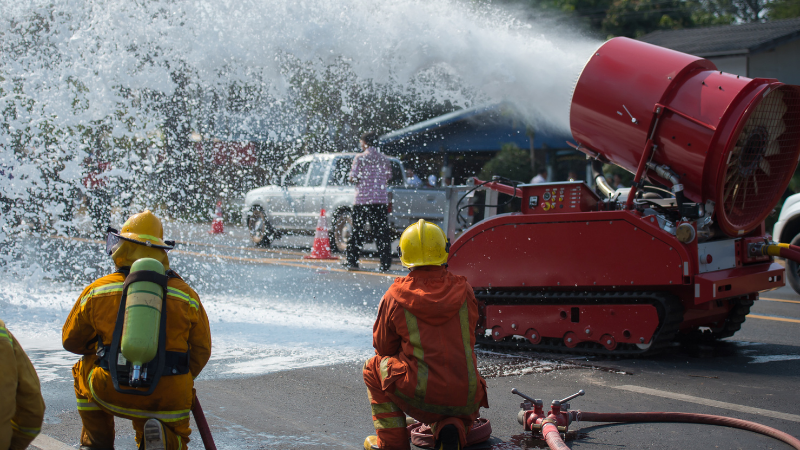
For decades, Aqueous Film-Forming Foam (AFFF) has been an important tool for fighting Class B flammable-liquid fires at airports, refineries, petrochemical facilities, military installations, and other high-hazard locations.
But the fire protection industry is now undergoing a major transition: moving away from fluorinated firefighting foams containing PFAS toward fluorine-free foam (F3).
Why Was Fluorine Used in Firefighting Foam?
Yes—traditional AFFF formulations contain fluorinated chemicals, including PFAS. These chemicals helped the foam rapidly spread across burning fuel, suppress vapors, and provide effective fire extinguishment.
The same properties that made PFAS useful in firefighting also created a significant environmental concern. PFAS are highly persistent and can remain in the environment and human body for long periods.
As scientific understanding and regulatory scrutiny have increased, manufacturers and fire departments have increasingly moved toward fluorine-free firefighting foams.
Did PFAS Affect Firefighter Health?
This is an important and complicated question.
Firefighters can be exposed to PFAS from multiple sources, including AFFF, turnout gear, and the fire environment. CDC/NIOSH reports that firefighters can have higher PFAS exposure than the general population, and occupational PFAS exposure has been associated with certain adverse health outcomes.
However, it would be inaccurate to attribute firefighter cancer or other health conditions solely to AFFF. Firefighters are exposed to many hazardous substances during their careers.
The concern surrounding PFAS has nevertheless become an important reason for reducing unnecessary occupational and environmental exposure.
Are All Manufacturers Moving to PFAS-Free Foam?
The industry is clearly moving toward fluorine-free foam, but the transition is not identical everywhere.
Different applications have different performance requirements, approvals, and regulatory requirements. NFPA is currently working on a Fire Service Roadmap specifically addressing the transition from legacy fluorinated foam to next-generation PFAS-free foam.
That shift accelerated in December 2022, when 3M announced it would exit PFAS manufacturing globally—a decision that also ended production of the Novec 1230 clean agent, as covered in The End of 3M Novec 1230.
Fluorine-free does not automatically mean environmentally harmless. Some F3 formulations use other surfactants that are also being studied for their environmental impacts.
What Should Facilities Do With Existing PFAS Foam?
There is no single nationwide deadline requiring every facility in the United States to replace all PFAS-containing foam. Requirements vary by state, application, facility type, and regulatory authority.
Facility owners should:
- Identify whether existing foam contains PFAS
- Review current federal, state, and local requirements
- Stop unnecessary training discharges of PFAS foam
- Evaluate approved fluorine-free alternatives
- Develop a proper collection, disposal, or destruction plan
- Decontaminate equipment where required
- Document the transition and future foam inventory
PFAS-containing foam should not simply be dumped into a drain or discharged onto the ground. EPA’s current guidance emphasizes managing PFAS-containing materials in ways that minimize releases and rely on appropriate destruction or disposal methods.
The Future of Firefighting Foam
The transition away from PFAS represents one of the biggest changes in the fire suppression foam industry in decades. The objective is not simply to replace one foam with another. The industry must ensure that the next generation of fluorine-free foams provides reliable fire performance while reducing environmental and occupational exposure concerns.
For facility owners, fire departments, and fire protection professionals, now is the time to inventory existing foam, understand applicable regulations, and develop a planned transition strategy.
The future of firefighting foam is changing—from fluorinated chemistry toward PFAS-free solutions.
Related Reading
- The End of 3M Novec 1230: What the Fire Protection Industry Needs to Know
- Halon 1301: Why It Was Phased Out—and Why Fire Protection Professionals Still Need to Know It
- The AIM Act and the Future of FM-200
Roshan Karki is a Special Hazards Subject Matter Expert for educational content created by Fire Tech Productions, Inc.


